

Thought Leadership
Public sector: Delivering Vision 2030 within a tighter budget
Protecting priority targets while maximizing the impact of public spending

Thought Leadership
Protecting priority targets while maximizing the impact of public spending
Saudi Arabia prepares its 2027 budget with most Vision 2030 targets on track and a fiscal envelope tighter than planned. That combination puts a practical question to every government entity: which programs carry its targets, and which can be staged or resequenced to make room inside the budget. This report sets out how to answer it before the 2027 budget year begins.
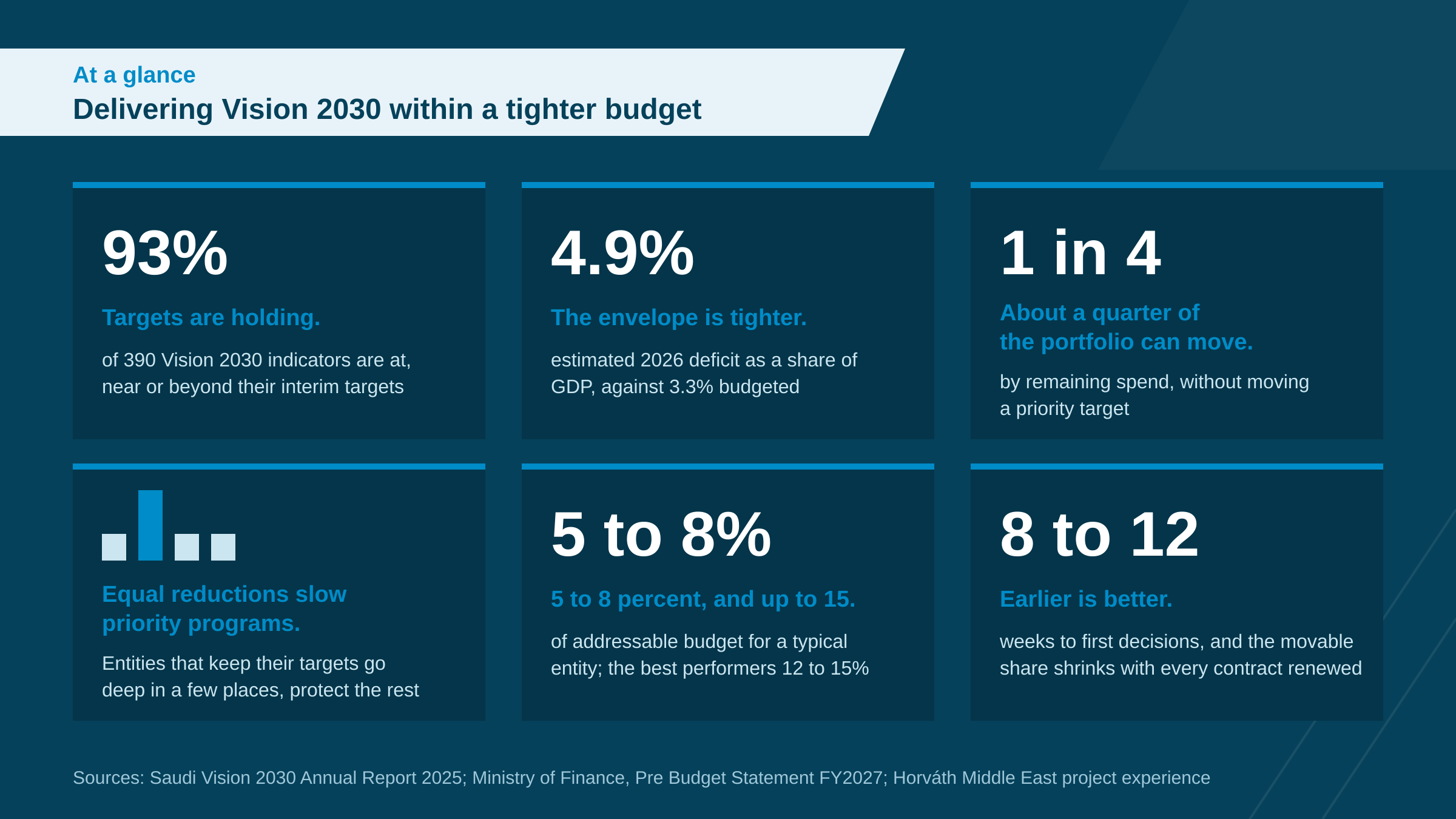
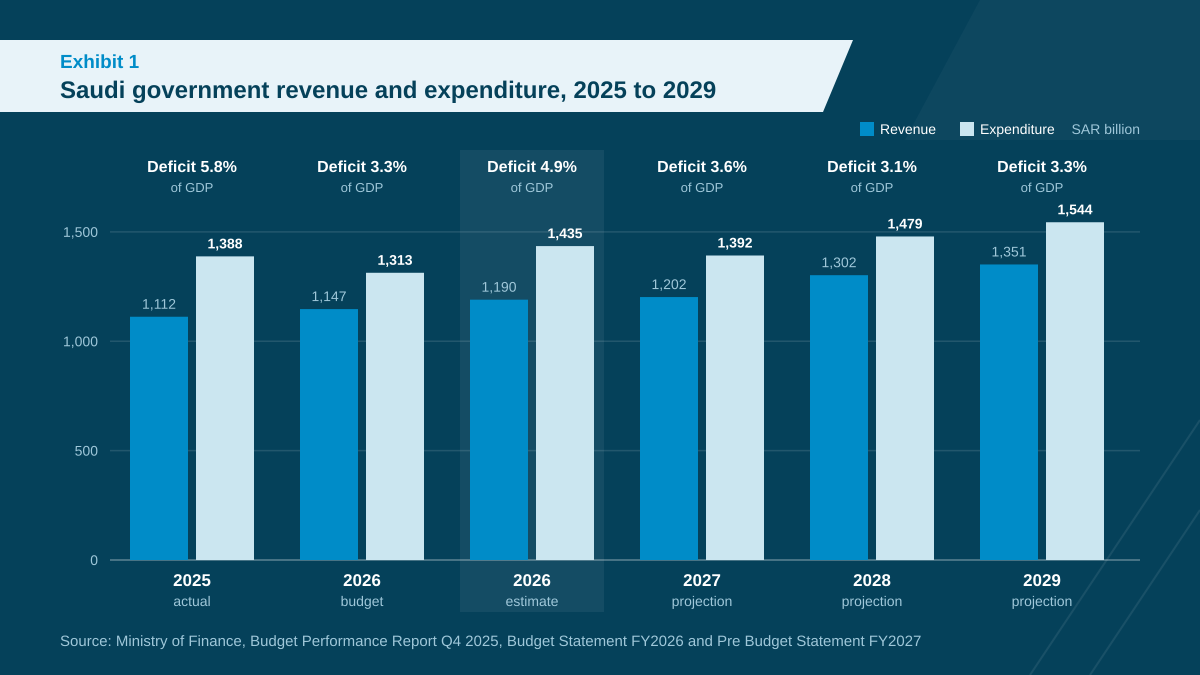
The fiscal envelope moved during 2026. The Ministry of Finance’s pre budget statement of 30 September 2026 now estimates the 2026 deficit at SAR 245 billion, 4.9 percent of GDP, and projects a 2027 deficit of 3.6 percent on spending of SAR 1,392 billion. The statement commits to continued spending on development and strategic priorities while maintaining fiscal sustainability.
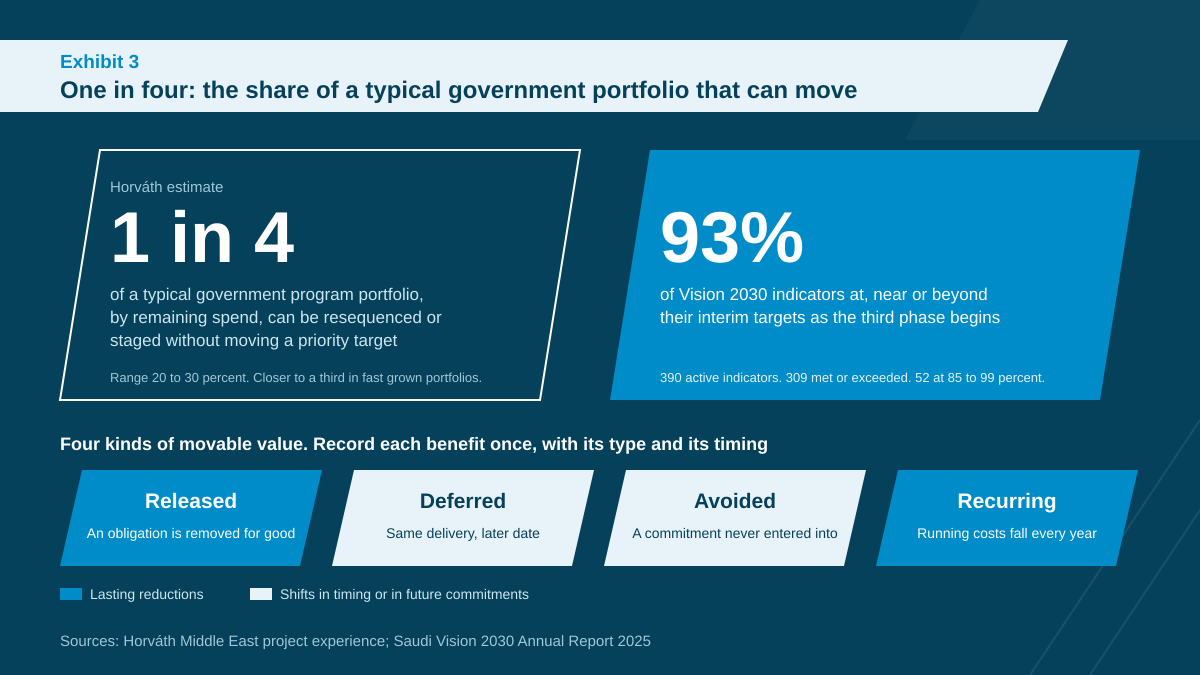
The targets are holding. The Vision 2030 Annual Report 2025 tracks 390 active indicators, and 93 percent are at, near or beyond their interim targets. Together, those facts leave each entity with one practical question: which of its programs carry its priority targets, and how much of the rest can move.
EXPRO defines expenditure efficiency as maximizing the impact achieved in relation to expenditure, and this report uses the same definition. The Finance Minister set the tone at the Budget Forum in December 2025, when he said that spending efficiency does not necessarily mean reducing expenditure.
A ministry of finance can set the envelope and decide what it will measure. Only the entity can say which of its programs carry its targets, so the weight of the third phase sits with entity heads and their executive committees.
When the budget circular arrives with a smaller number, the quickest figure finance can defend is the same percentage from every program. It is fast and singles nobody out, so it needs no debate about merit. The cost shows up later, in the programs that carry the targets.
In our portfolio work with public entities in the region, we see five habits in the entities that keep their priority targets on track. They know which programs carry which targets. They manage a portfolio, not a list of projects. They hold current evidence of value. They prepare their options early. And they do not reduce every line by the same percentage, going deep in a few places and protecting the rest.
We estimate that roughly a quarter of a typical government program portfolio, measured by remaining spend, can be resequenced or staged without moving a priority target. The range is 20 to 30 percent, and in portfolios that grew quickly during the second phase of Vision 2030 it can be closer to a third.
The mechanism is staging. Many programs can run a smaller first phase and keep their target intact, with the first phase proving the model and the second scaling it. Movable value comes in four kinds, released, deferred, avoided and recurring, and each belongs on its own line, with the year it takes effect.
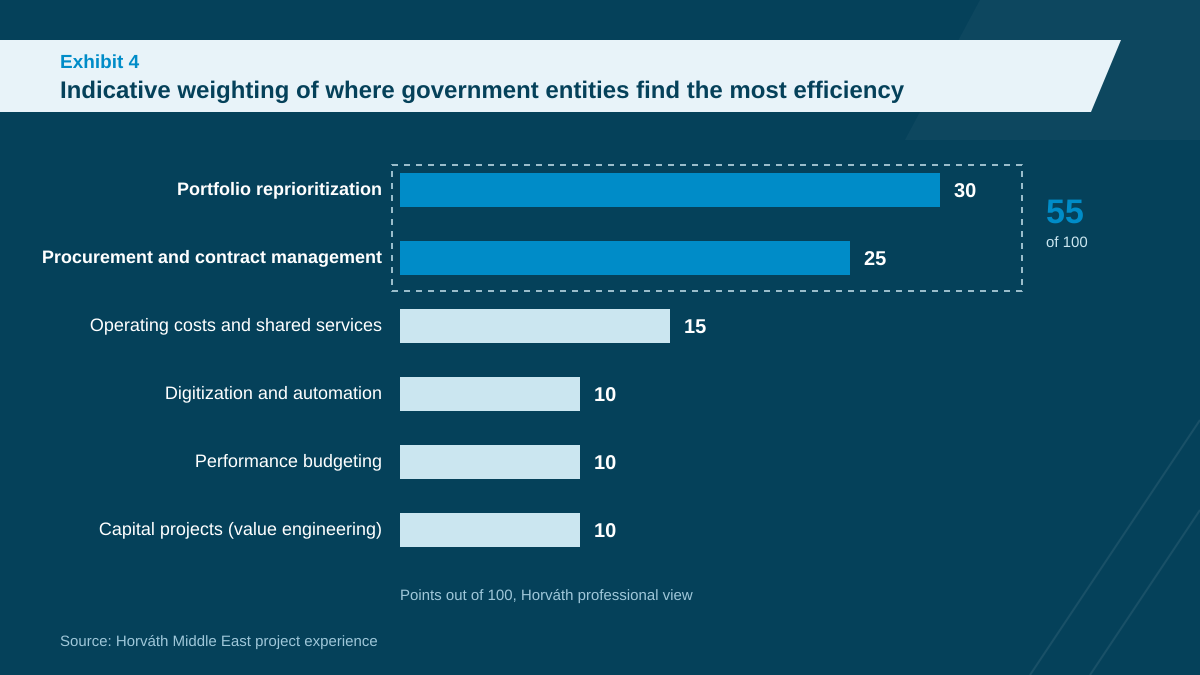
Weighted by where we see government entities find the most efficiency without slowing their priority programs, portfolio reprioritization comes first at 30 points out of 100, with procurement and contract management close behind at 25. Operating costs and shared services follow at 15 points, and digitization and automation, performance budgeting and capital projects at 10 each.
Procurement and contract management lower the cost of what is bought without touching the scope that matters.
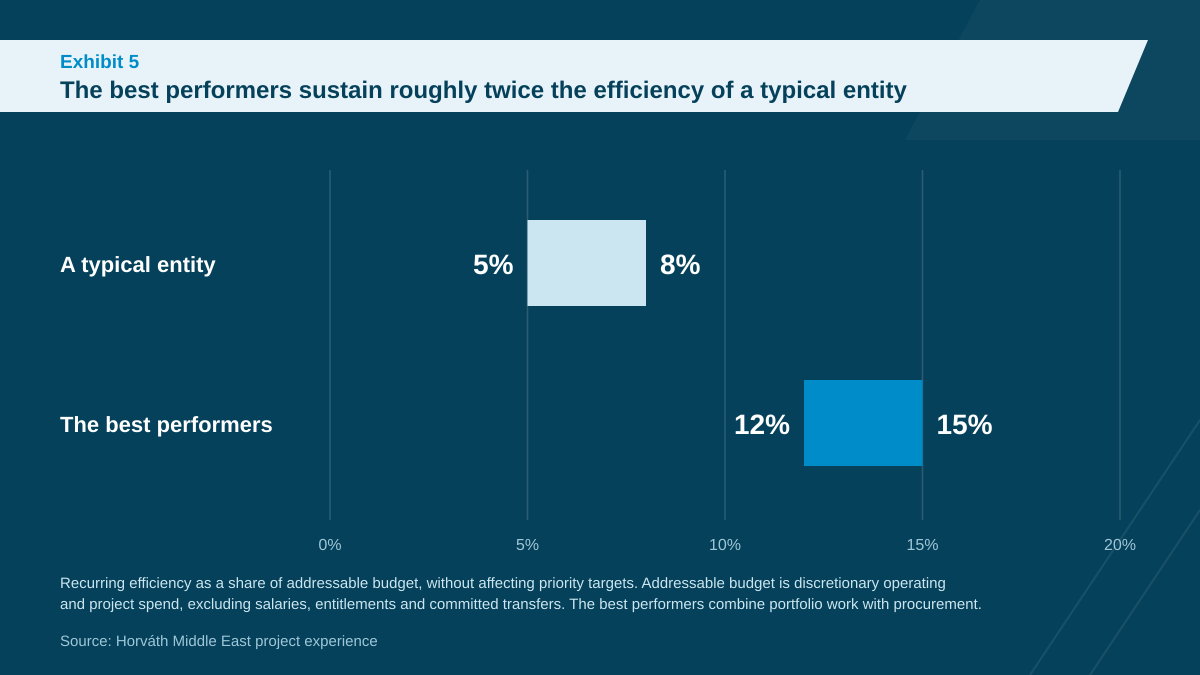
Measured against addressable budget, we estimate that a typical government entity achieves efficiency of 5 to 8 percent without affecting its priority targets, and the best performers 12 to 15 percent. They get there by combining portfolio reprioritization with procurement, and neither one alone gets an entity into that range.
Where the circular asks for a net reduction, the same ranking applies: released and avoided amounts go to the envelope first, and deferrals are used only where the second phase has a funded date.
Contracts already signed are the real limit on how much of a portfolio can move. An entity with a mature portfolio commits a large share of next year’s spend before the budget year begins, so the movable share shrinks the later in the year the review takes place.
First decisions in a portfolio review typically land in 8 to 12 weeks. The earlier a review starts, the more of the contract register is still open.
Start from the targets. List the priority targets the entity is accountable for, then map each material program to the targets it moves. Until the map exists, any reduction is a guess.
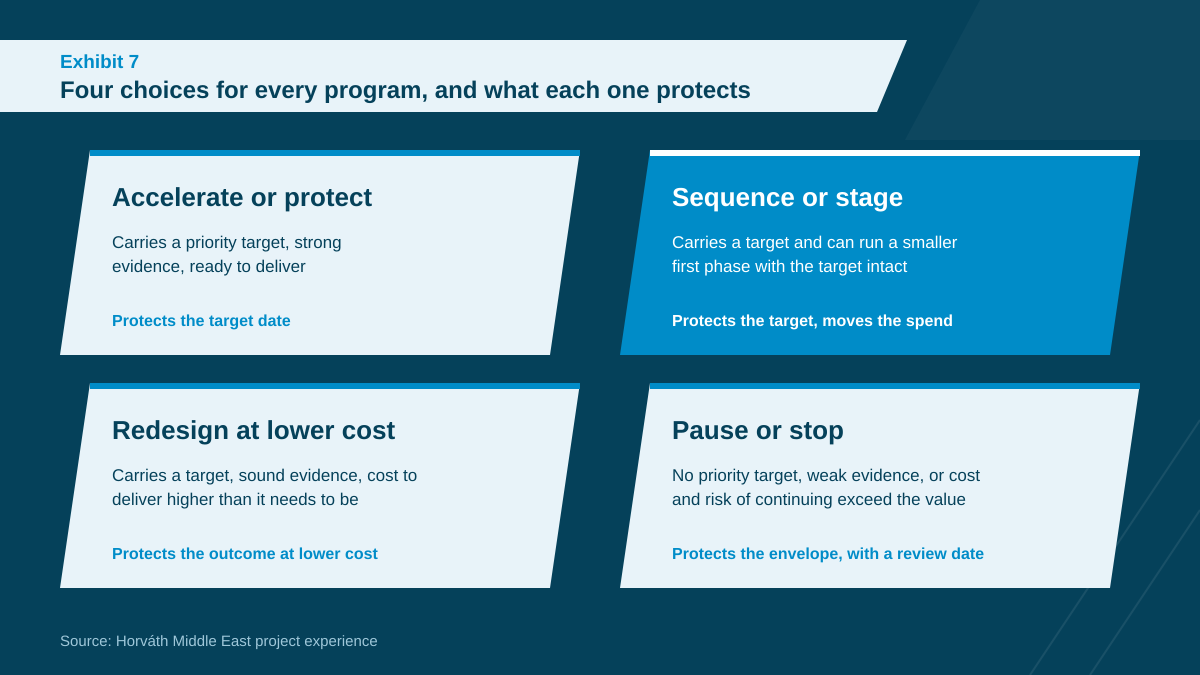
Rank the programs on four tests: contribution to a priority target, strength of the value evidence today, delivery readiness, and the cost and risk of pausing. Then give every material program one of four decisions: accelerate or protect, sequence or stage, redesign at lower cost, or pause or stop.
Strategy proposes. Finance assures the numbers. Each line owner commits in writing to what their program must still deliver, and the entity head or executive committee decides.
A review that ends in a ranking, without a recorded decision, tends to unravel when the circular arrives, because finance still needs a number and the equal reduction is the only instrument left. Every decision therefore carries a review trigger and a date.
Service quality, coverage, waiting times and the citizen’s experience move Vision targets as surely as any financial measure. Those outcomes belong in the review with the same discipline as cost: a measure, a baseline, an owner and a date.
Pairing each cost measure with a quality measure keeps a cheaper but worse service from counting as an efficiency gain.
EXPRO’s mandate includes reviewing the initiatives and programs of government entities, developing requirements and targets for the efficiency of public expenditure and projects, and working with entities to form internal expenditure efficiency teams. The Ministry of Finance has said it will use the impact of spending to direct resources to priority programs and projects.
Two pieces of work are worth starting this quarter: the map of which programs carry the entity’s priority targets, and the contract register laid next to it, with renewal dates and the cost of stopping.
Eight questions before the 2027 budget year begins
Which of our programs carry our priority targets, and is that written down?
How much can we free up without moving a target, and in which of the four forms?
Which contracts renew before our review ends, and what does stopping each one cost?
What do we stage first, and what does its second phase depend on?
Where would an equal reduction land, and which targets would it slow?
For outcomes that are not financial, do we have a measure, a baseline and an owner?
Who decides, who assures the numbers, and does every decision carry a review date?
Does our submission use the terms EXPRO and the Ministry of Finance already ask for?
Horváth Middle East works with government entities on these decisions, increasingly with the CFO and the head of strategy at the same table: portfolio reviews and reprioritization ahead of budget submissions, value and benefits tracking that finance trusts, procurement and contract reviews, and operating model and shared services consolidation.
We make strategy happen.
By Saad Hamam, Partner and Managing Director, and Raad Abwini, Principal, Horváth Middle East.